
Join us as we explore K-libraries through the milestones and initiatives that have shaped their renowned digital innovation in the library and information fields, advancing social inclusion and expanding equitable access to knowledge.
Historical Resilience: From Post-War Recovery to Intellectual Foundations
For WLIC 2026 participants, the evolution of Korean libraries presents a compelling narrative of international solidarity and rapid growth.
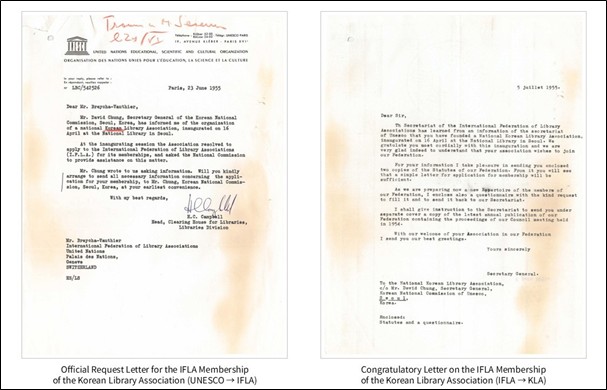
After the Korean War, the Korean Library Association (KLA) was re-established in April 1955, demonstrating remarkable resilience. Just five months later, on 8 September 1955, the KLA became an official member of the International Federation of Library Associations and Institutions (IFLA), a testament to its remarkable momentum.
This early connection to the global library community laid an important foundation for reconstruction, supporting the introduction of modern library and information systems. Today, as South Korea prepares to host its second World Library and Information Congress—following its first in 2006—this legacy highlights the nation’s enduring commitment to libraries as key pillars of knowledge continuity and national identity.
Resource: Letters for the IFLA Membership of the Korean Library Association
Digital Frontier: Powering Transformation through AI and Smart Systems
The K-Library model reflects the practical realisation of the congress theme, ‘Libraries Powering Transformation’, through its sophisticated digital infrastructure. South Korea is currently leading a digital transformation by redefining libraries as immersive ‘Knowledge Labs’ and ‘Intellectual Basecamps’.
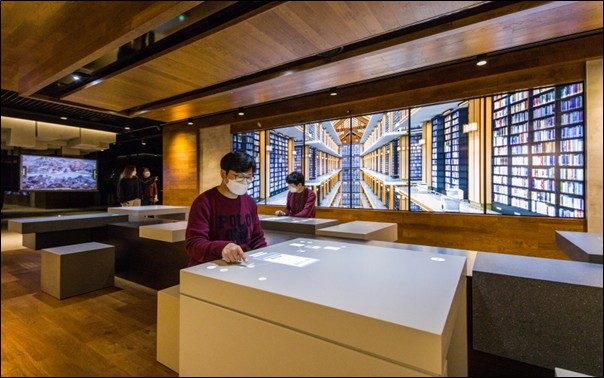
More than just automation, the K-Library integrates advanced artificial intelligence (AI) and big data to provide personalized, technology-driven services, including immersive library environments and AI-powered curation systems. These technologies are seamlessly integrated into the library space, allowing visitors to experience the transformation of traditional records into dynamic digital content.
Together, these developments demonstrate how Korea leverages innovation to promote social inclusion and expand equitable knowledge.
Resource: Immersive Reading Room, Digital Library of the National Library of Korea
Cultural Infrastructure: Shaping Social Engagement and Cohesion
South Korea’s reading ecosystem demonstrates how libraries play a central role in community life.
Major literary events such as the Seoul International Book Fair and the Busan Book & Contents Fair bring together literature and cultural content. Professional gatherings such as the KLA General Conference support library professionals for collaboration and knowledge exchange.
This continues through national initiatives such as Library Day (12 April) and Library Week (12–18 April), annual observances that celebrate the role of libraries as essential public institutions. This year’s theme, ‘A Small Unfolding in the Library, a Big Opening to the World’, Korean libraries are increasingly seen as dynamic hubs that connect knowledge, people, and ideas.
Together, these developments reflect how the K-Library model is evolving beyond traditional cultural venues into spaces that support everyday civic life.