And that’s a wrap for IFLA WLIC 2026! The final numbers are in: 3,191 delegates, of whom 50% first-timers, from 111 countries and territories came together for over 200 sessions packed in just three days. Over 1500 delegates were from our host country, South Korea. We also had 350 speakers, 200+ poster sessions, 50 exhibitors and more than 200 volunteers!
It is hard to express in words our gratitude for everyone who travelled, from near and far, and took the time to contribute to this incredible event. You make WLIC special, thank you.
Catch highlights of the conference on Instagram, head over to Flickr to access some incredible photos, go to IFLA’s YouTube channel for recordings of Auditorium sessions, and read on for some key moments from the third and last day!
Closing Ceremony
The closing session is a time to look back, deep reflect on the many sessions, and share in the achievements of the award winners announced out during the busy week.
While there is so much to celebrate, the end of an IFLA WLIC is always bittersweet. We are filled with fondness and pride for everyone’s achievements and for what we accomplished together, but impatient at the thought that next time we will all be in a room together will be in one year.
But, we have great things to look forward to! Next year will mark IFLA’s centenary, and we had already a glimpse at IFLA WLIC 2027 in a captivating video. IFLA was founded in the United Kingdom 100 years ago, a connection which will make the next congress very special.
Thank you once again to the Korean National Committee for their hard work and for being such incredible hosts to our thousands of delegates.
Safe travels to everyone, we will see you all soon!
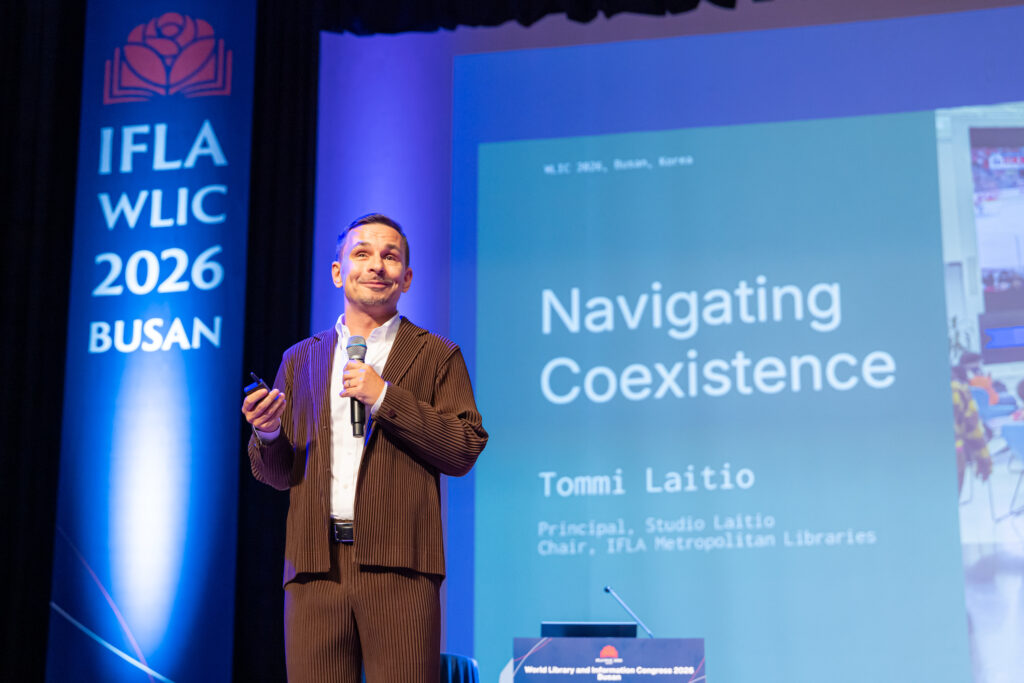
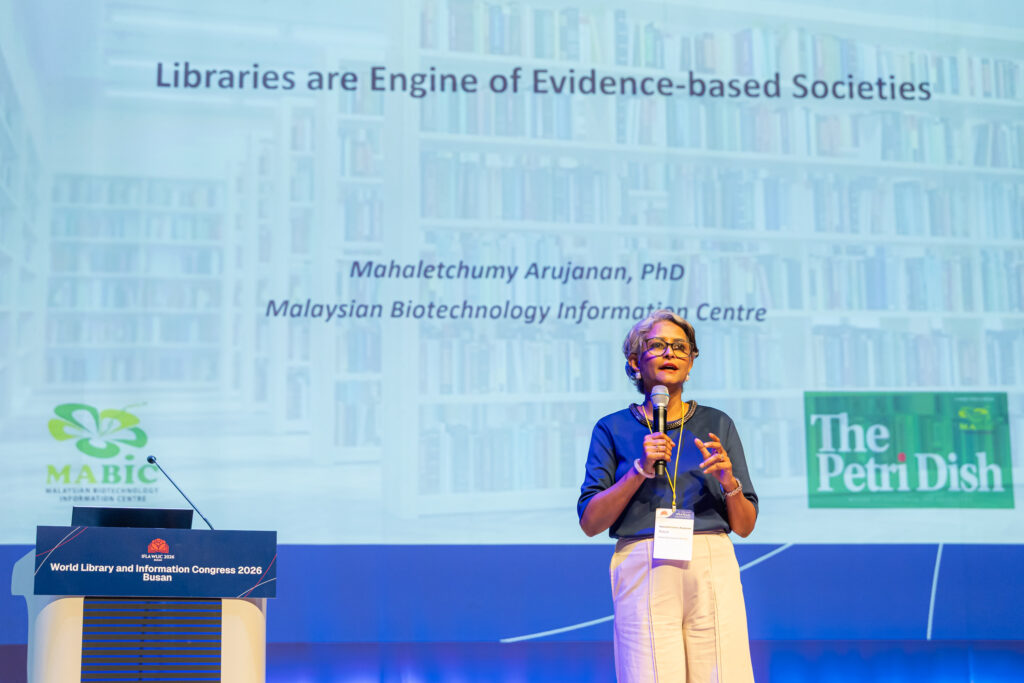
Keynote by Mahaletchumy Arujanan (Libraries, Media and the New Science Commons: Connecting Research with Society) and Tommi Laitio (Navigating Coexistence)
Day three’s keynote session brought together two powerful perspectives on the role of libraries in an increasingly complex world.
Mahaletchumy Arujanan challenged libraries to become active partners in communicating science, helping communities navigate misinformation, emerging technologies and complex societal challenges. She highlighted the potential of libraries to make science more accessible through dialogue, creativity and community engagement.
Tommi Laitio then explored how libraries can help people “coexist across difference.” Drawing on examples from cities around the world, he argued that friction is not necessarily something to eliminate, but something libraries can help communities navigate. His concept of convivencia — finding the space between harmony and conflict — offered a compelling framework for libraries as places where people can encounter difference, build trust and share public space.
IFLA Green Library Award 2026
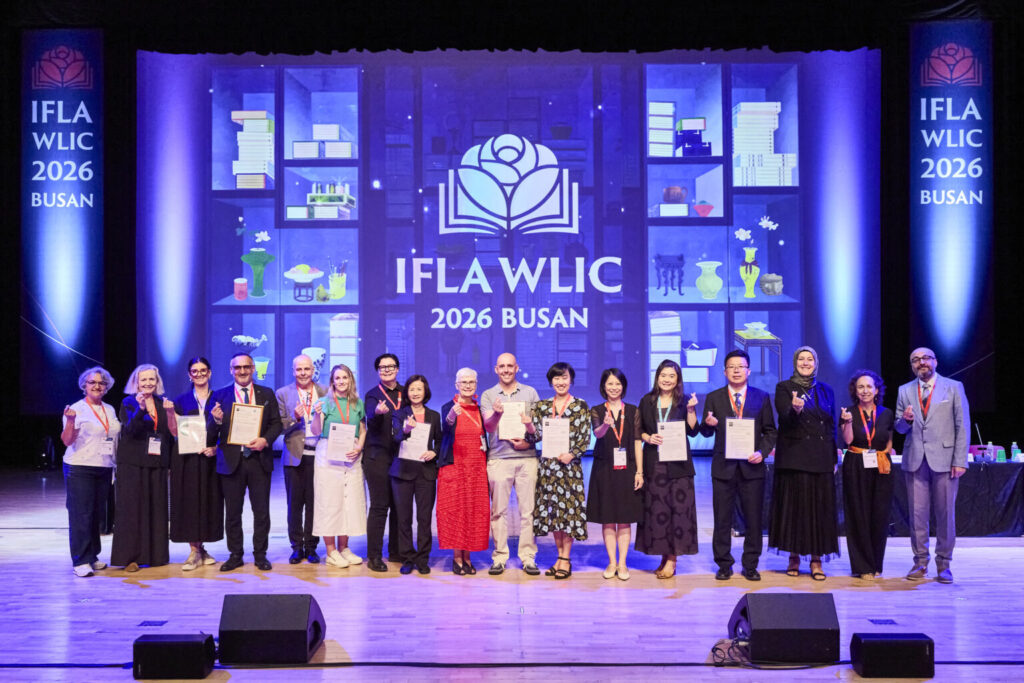
Presented by IFLA’s Environment, Sustainability and Libraries Section (ENSULIB), the IFLA Green Library Award is given out each year to libraries and projects that best communicate their commitment to environmental sustainability, a role which is becoming more and more important every year.
The prize is sponsored by Library Juice Academy and De Gruyter Brill Publishing, and strives to create awareness of libraries’ social responsibility and leadership in environmental education and to support the worldwide green library movement.
CEDREAK (Centre for Documentation and Resources for Environmental Education in Cantabria, Spain) won first place in the Best Green Library Project category, with “Small Library, Big Engine: CEDREAC’s Circle of Environment & Participation”. Runner ups were Yonghak Library (South Korea) with “The living library: A policy framework for urban ecosystem integration”, and Lien Ying Chow Library at NGEE ANN Polytechnic (Singapore) with “Library of Tomorrow – Blueprint to Sustainable Futures”.
In the category Best Green Libraries/Grand Scale Projects, the award went to Rami Library(Türkiye), with “Rami Library: Transforming a 19th Century Historic Barracks into a Climate-Resilient Urban Commons”. Jinjiang Library (China) got second place with “Greenwood Neighborhood Library”, while Munster Technological University (Ireland) ended third with “The ideal couple? Marrying Biophilia and Sustainability in MTU Libraries”.
Full details on the session are in ENSULIB’s news post.
More sessions from Day Three
Collections Under Threat: Anticipating, Managing, and Preventing Threats to Library Collections
How can libraries protect their collections from physical, digital, and environmental threats? This session offered answers and to this end, presenters highlighted the importance of preservation, cybersecurity, reliable backups, metadata, and maintaining access to collections during disruptions.
Resilience requires shared responsibility and long-term planning. Libraries need to assess risks, prioritise valuable collections, protect digital information, and maintain trust through authenticity, privacy, transparency, and accountability.
Libraries Transforming Lives Through Lifelong Literacies
Libraries have a central role addressing the diverse, life-long literacy needs of their communities. From connecting literacy with fitness to developing research literacy in children, libraries are adopting unique and creative approaches to literacy engagement. The metric for life-long literacy is not whether patrons had their questions answered, but whether “they leave curious enough to keep going” (Shari Werb, USA, Library of Congress).
Rethinking Reference in the AI Era
While Artificial intelligence (AI) is reshaping reference services, it is not replacing the librarian. The presenters at this session discussed how library patrons are interacting with AI tools, how librarians can support AI literacy, and the role that librarians play in mediating access to and trust of AI tools and responses. This session highlighted the ways in which authority in the AI era has become negotiated, and the importance of training library staff to handle AI-related questions by developing their own AI literacy and providing a shared vocabulary for librarians to use in their work.
Cultural Memory in Motion: Capturing and Documenting Film, Music, and Emerging Media
This session’s case studies ranged from an audio archive so small it didn’t meet the threshold for grant funding, to the 20th century audio-visual archive of the Catholic church in Italy, to the multi-modal collection of Disney animation studios. The audience learned about challenges in finding the equipment to “read” the material to capturing metadata, and identifying more than 300 voices of interviewees.
The discussion touched on issues associated with copyright, digitalisation, and replication of preservation of these types of archives.
Become an IFLA Member: benefit from our year-end membership offer by joining now!
Did you know that if you join NOW as an IFLA member or affiliate, you pay at the 2026 rate, and your fee will cover your membership for the rest of the year and all of 2027!
Read on to find out more about how to become an IFLA Member.